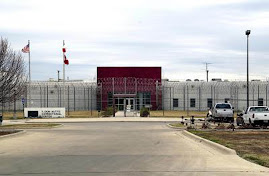
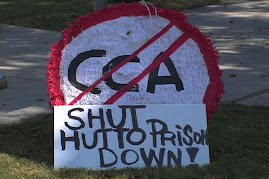
Outgoing 9-1-1 calls placed by immigrants detained at T. Don Hutto Residential Facility in Taylor will soon be blocked after Immigration Customs Enforcement changes the phone system in the former prison.The block affects telephones used specifically by immigrants housed in the facility. Also blocked will be all incoming phone calls.
"(T. Don) Hutto residents already have access to emergency attention by contacting any on-site resident supervisors. Medical professionals and facilities are also on site and can provide immediate services inside the center while ... personnel alert outside emergency responders through the 9-1-1 system, if deemed necessary," Rusnok said in an e-mail response.
The change came as part of a change in the contract between Williamson County and Immigration Customs Enforcement billed as "Modification ... relating to Low Cost Telephone Services" on the county commissioners' agenda Tuesday.
The commissioners voted 5-0 in favor of the item with no discussion of the matter. After the vote, County Judge Dan Gattis said he was unaware the alteration in the agreement effectively blocked outgoing 9-1-1 phone calls.
Regional Spokesman for ICE Carl Rusnok said the ability of residents at T. Don Hutto to place 9-1-1 phone calls is unnecessary because of the presence of trained medical professionals inside the facility.
Rusnok also said blocking 9-1-1 calls prevents any possibility of abuse.
Local League of United Latin American Citizens member and T. Don Hutto critic Jose Orta said ICE and Corrections Corporation of America, which operates the facility, were "covering themselves" from any possible calls to police.
He referenced an alleged sexual assault that occurred in the facility in May of 2007. That incident led to the firing of a CCA employee after he was caught on a surveillance camera sneaking in and out of a detainee's cell.
No charges were ever filed against the employee in that instance because of a now-corrected loophole in federal law.
The order approved Tuesday also expresses that phones should have access to toll-free numbers that will allow residents to use prepaid phone cards they purchase while at the facility, though it makes no mention of toll-free numbers to consulates or embassies.
"(Immigrants are) already hogtied as far as reaching out into the community," Orta said. "I get calls all the time — desperate families — they Google and see they are at the facility and sometimes they can't find their family members. If (residents) can't call out without these telephone cards, who knows how they'll ever get in touch."
Assistant County Attorney Hal Hawes, who submitted the deal to the commissioners' court, said blocking 9-1-1 calls would not cause any problems at the facility.
"They (CCA employees) provide security already," Hawes said. "They have a good sense of when 9-1-1 needs to be called."
The text of the alteration refers to 10 telephones being purchased and service with the capabilities of blocking 9-1-1 calls. The cost of the alteration is $942.01, a relatively small expenditure for the county.
Orta only partially blamed commissioners for letting the agreement slip through without any debate.
"This is the sad part about the county commissioners; they're not privy to all that goes on in T. Don Hutto. Every time they amend their contract ... ICE ... is not going to be forward about their intentions," he said.
Grassroots organizer and frequent protester of the facility Bob Libal said not allowing immigrants to place emergency phone calls is unsafe and that residents need access should they feel a need to call the police.
"It certainly doesn't seem like a good safety measure. And if ICE is upholding (T. Don) Hutto as a place that is safe and secure, that doesn't seem like a very appropriate action," Libal said.
Thursday, July 24, 2008
Taylor Daily Press: ICE Blocks 911 Calls from Hutto
Philip Jankowski reporting:
Subscribe to:
Post Comments (Atom)

2 comments:
I'm surprised that 911 calls were ever allowed from the resident-use phones at that facility. As I read between the lines, I have a feeling that 911 never was accessable from those phones. It's just now being put on the record for some reason.
While Orta is flabberghasted that the Wilco commissioners know so little about that facility, and by contrast, he knows so much, I'm surprised that he hasn't read the family detention standards, specifically the section regarding telephone access for residents. If he had, he would see that the standards specifically state that if a person asks for a phone call to family, friend, whomever, wherever, they will receive it free of charge. There is no limit to calls or length put into the standards. There is no difference in accessability or number of calls between whether it's a call to family or legal counsel. The cards that residents purchase for ten dollars, which give them two hours of talk time, are a convenience item so they can call from the housing area at any time 24/7 without having to go to an office and ask a staff member to use the phone.
Every new resident is told during orientation that sexual contact is not allowed, and if they become aware of any such contact, there are free numbers posted on bullitin boards and next to every phone to call the Office of Inspector General and report that conduct. That's the way it has been since the first resident was processed into that place.
The idea that Orta is considering his main safety argument for allowing use of phones to call 911 that incident with that one guard and that one resident... didn't that happen about three times over a number of days? Did that guard physically keep her from using the phone when he was off shift to call anyone at all? Doubtful. My guess is that she never would have called anyone at all even if she had a free phone right in her room.
Every housing area has staff members, back up staff members, roving staff members, all in radio communication and all trained first responders with fully equipped medics on site less than a minute away.
If you want to argue the need for the laws which are broken to get these people detained, that's fine. It just seems really silly to say that everyone is ignorant because they're not allowing 911 access from residents who are fully supervised at all times by people that are trained to deal with anything and who have 911 access when it's needed.
I'd trust the judgement of paramedics on site to determine when 911 needs to be called before I'd trust the judgement of a 7 or 8 year old Guatemalan immigrant child playing on the phone.
Salvadorano,
Do you have anything but a "feeling" to support that "911 never was accessable (sic) from those phones"? Or "guesses" about the actions of female detainees? If you're going to take Orta to task for his comments, it'd be nice if the conversation addressed the facts, not your feelings.
Speaking of facts, The "Telephone Access" Family Residential Standard (http://www.ice.gov/pi/familyresidential/index.htm) states that there IS a difference between legal calls and other calls:
V.1.b states "Generally, residents or the persons they call are responsible for all the costs of telephone calls; however, there are exceptions as required below."
V.5 is too long to quote directly, but states that detainees have direct and free calls to local immigration courts, federal and state courts, consular officials, Office of the Inspector General, the United Nations High Commissioner for Refugees, Legal representatives, government offices with records pertaining to immigration cases, immediate families or others for residents in personal emergencies.
V.6 states "A facility may neither restrict the number of calls a resident places to his or her legal representatives nor limit the duration of such calls..."
V.4.a allows the facility to restrict regular calls based on demand.
There is, therefore, a difference between the restrictions on legal and other kinds of calls. If CCA isn't restricting calls at Hutto, so much the better, but restrictions are clearly allowed for in the standards you cited.
In addition, you claim that information about sexual contact has been given in orientations "since the first resident was processed into that place." While orientations on policies and procedures are now required by both the Hutto Settlement and the Family Residential Standards (which are also the result of the Hutto Settlement and Flores V. Reno), multiple detainees verified that they received no orientation in Hutto's early days. If the orientations had been satisfactory, improvements would not have been included in the settlement, because there would have been no need. My understanding is that this has been remedied--thanks to the lawsuit and public pressure. This blog contains information on the history of Hutto, the lawsuit, and changes at Hutto, if you're interested in learning more.
The article also states that there was previously a "federal loophole" that prevented the staff person (who had sexual contact with a detainee) from being prosecuted. And doesn't the fact that he was a staff member make detainees less likely to turn to staff members for help? Is it not reasonable to assume some fear of retaliation or intimidation on the part of detainees when a staff person engages in this kind of behavior? There's a reason why sexual contact is completely forbidden. The power relations between detainees and staff are always unequal, and this makes equal consent impossible. The same is true for teacher and students, bosses and employees. To speculate about whether or not the female detainee would have used the phone completely misses the point. This has been (rightfully) acknowledged by CCA and ICE, unless your insider information suggests that those apologies were all talk and things like that happen all the time. Hopefully, ICE, CCA and the various subcontractors take their jobs more seriously than that.
Post a Comment